
Writing Curriculum
Writing Curriculum
Writing with purpose, audience and adventure
At Amington Heath Primary School and Nursery, writing is never taught in isolation.
Our writing curriculum is rooted in the Adventure Curriculum. Children write because they have something meaningful to say, a clear purpose for writing and a real or imagined audience to write for.
High-quality texts, experiences, discussion and vocabulary sit at the heart of writing. Children encounter rich models, explore how successful writing works, rehearse their ideas and then apply what they have learned to create writing of their own.
We want children to leave Amington Heath as confident, imaginative and increasingly independent writers who can communicate effectively for different audiences and purposes.
 Writing Through the Adventure Curriculum
Writing is closely connected to our mini-adventures.
Wherever possible, children write within a meaningful curriculum context. Their writing might be inspired by a high-quality text, a Stunning Start, a visitor, an investigation, a historical event, a performance, a trip or the wider learning taking place within an adventure.
Children are encouraged to understand:
- why they are writing
- who they are writing for
- the features and conventions of the form they are using
- the vocabulary and knowledge they need in order to communicate effectively
This gives writing purpose and helps children see it as a powerful means of communicating ideas rather than simply completing an English task.
Our Writing Process
Across school, children are supported through a consistent writing process:
Read it
Children encounter strong models of the type of writing they are going to create. They read as writers, exploring vocabulary, structure, sentence choices and the techniques authors use to communicate effectively.
Rip it
Children investigate how successful writing has been constructed. They identify important features, explore language choices and consider how the writer has achieved a particular effect.
Rehearse it
Before writing, children have opportunities to develop and rehearse their ideas. This may include talk, drama, storytelling, sentence rehearsal, vocabulary work, shared writing and teacher modelling.
Write it
Children apply their learning to produce writing with a clear purpose and audience. Teachers support children to draw upon their knowledge of vocabulary, grammar, sentence construction, spelling, handwriting and the conventions of different forms of writing.
Review it
Children reread their work and learn to evaluate its effectiveness. As they become increasingly independent, they edit and improve vocabulary, sentence construction, punctuation, spelling and organisation while considering whether their writing achieves its intended purpose.
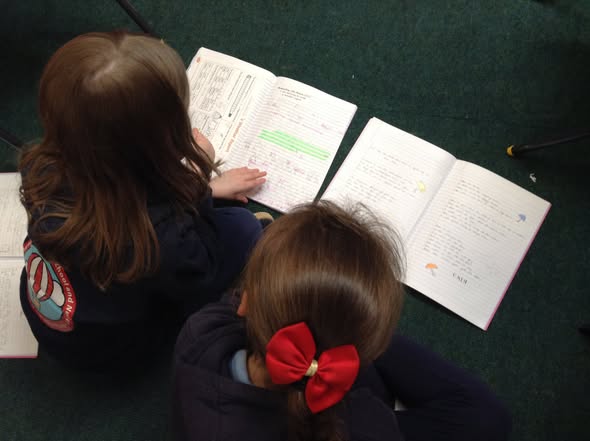
Oracy Before Writing
Talk is an essential part of becoming a successful writer.
Our oracy golden thread runs directly through the writing curriculum. Children need opportunities to hear language, develop vocabulary, explain their ideas and rehearse sentences before they are expected to put those ideas onto paper.
Children regularly:
- discuss texts and ideas
- explore and collect vocabulary
- retell and rehearse stories
- say sentences aloud before writing them
- use drama and role play
- share ideas with partners and groups
- read their writing aloud and consider how it sounds to an audience
This helps children develop confidence, sentence fluency and increasingly precise language.
Beginning the Writing Journey
The foundations of successful writing begin long before children are expected to produce formal written work.
Little Learners and Nursery
Our youngest children develop the physical, language and imaginative foundations needed for writing through play, talk, stories and carefully planned experiences.
We use Squiggle While You Wiggle and Dough Gym to help children develop gross and fine motor strength, coordination and control.
Alongside this, children have frequent opportunities to mark-make, draw, talk, tell stories and experiment with early writing in meaningful contexts.
Drawing Club
As children develop, Drawing Club brings together stories, imagination, vocabulary, drawing and early writing.
Children explore characters, settings and adventures, develop ideas orally and begin to communicate increasingly sophisticated ideas through drawing and writing.
Curious Quests
In Year 1, children build on these foundations through Curious Quests, continuing to develop imagination, vocabulary, storytelling and purposeful writing as they move towards the broader Adventure Curriculum approach.
This creates a clear progression from physical readiness and oral language, through drawing and storytelling, into increasingly confident and independent written communication.
Spelling
Spelling is taught explicitly and is also reinforced through children’s everyday reading and writing.
We use Grammarsaurus to support the systematic teaching of spelling.
Children also use the Morphs online programme to practise and consolidate spelling both in school and at home.
Teachers encourage children to apply taught spelling patterns and word knowledge within their independent writing, while also developing strategies for checking and correcting unfamiliar words.
 Handwriting and Presentation
Developing fluent handwriting allows children to concentrate increasingly on what they want to say rather than on the physical act of writing.
Following the early gross and fine motor development supported through Dough Gym and Squiggle While You Wiggle, we use the Morrells Handwriting scheme to teach letter formation, joining and fluent handwriting progressively.
We want children to develop handwriting that is comfortable, legible and increasingly fluent, while taking pride in the presentation of their work.
Grammar and Vocabulary
Grammar is taught both explicitly and through high-quality reading and writing.
Children learn how grammatical choices affect meaning and how different sentence structures, punctuation and vocabulary can be used for particular purposes and audiences.
Vocabulary development is particularly important. Through reading, oracy, curriculum experiences and direct teaching, children build an increasingly rich vocabulary which they are encouraged to use precisely and confidently in their writing.
An Inclusive and Ambitious Writing Curriculum
We have high expectations for all children while recognising that children may need different routes towards becoming successful writers.
Support may include:
- additional oral rehearsal
- visual prompts and vocabulary support
- sentence scaffolds and models
- shared or supported writing
- additional spelling or handwriting practice
- assistive technology where appropriate
- adapted recording methods
- targeted support for fine motor, language or literacy needs
Adaptations are used to remove barriers while maintaining ambition and ensuring children continue to develop the knowledge and skills they need as writers.
Writing Beyond the English Lesson
Children use writing throughout the Adventure Curriculum.
They may write as historians, scientists, geographers, designers, performers or campaigners, applying their writing skills while demonstrating subject knowledge.
Writing also provides opportunities to communicate beyond the classroom through presentations, performances, letters, publications, displays and work created for authentic audiences.
This helps children understand that writing has real purpose and value in the world beyond school.
Our Writing Curriculum
Our Writing Curriculum Map sets out how writing develops progressively across the school, including the forms of writing, knowledge and skills children encounter as they move through each year group.
View our Writing Curriculum Map
Find Out More
If you would like more information about our writing curriculum, please speak to your child’s class teacher or contact the school office.
Telephone: 01827 337465
Email: office@amingtonheath.staffs.sch.uk